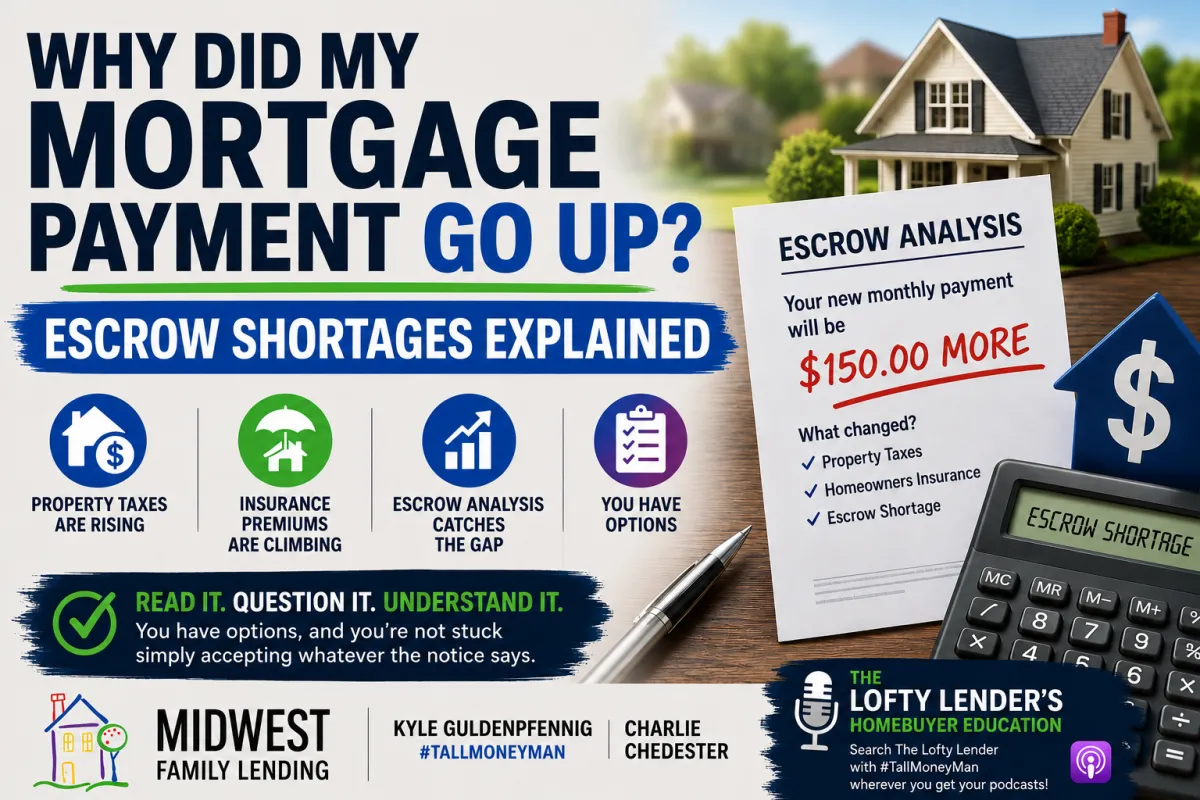
Why Did My Mortgage Payment Go Up? Escrow Shortages Explained
If you didn't refinance, didn't miss a payment, and your mortgage bill still jumped by $100, $150, or more this year — you're not alone, and you're not being overcharged. In the latest episode of The Lofty Lender's Homebuyer Education, Kyle Guldenpfennig (#TallMoneyMan) and Charlie Chedester of Midwest Family Lending break down exactly why escrow payments rise, why it happens most often in October through January, and what you can actually do about it.
Whether you're a first-time buyer, a move-up buyer, or a longtime homeowner, this is one of the most common calls Kyle and Charlie get every year — so let's clear it up.
What Is an Escrow Analysis, and Why Did My Payment Change?
Most mortgage servicers perform an escrow analysis once a year, typically in the fall. Your escrow account is the pool of money your lender collects each month, on top of principal and interest, to pay your property taxes and homeowners insurance on your behalf when those bills come due.
During the analysis, your servicer compares what they actually paid out for taxes and insurance against what they collected from you over the year. If your property taxes or insurance premium increased — which they have almost everywhere over the last few years — there's now a gap between what was collected and what was needed. That gap is your escrow shortage, and your servicer will either ask you to pay it as a lump sum or spread it across your next 12 monthly payments, along with a slightly higher ongoing collection amount to cover next year's expected increase.
As Charlie put it on the show: "They're just trying to make sure the fluctuation isn't large." Small changes of $10–$30 a month rarely raise an eyebrow. It's the bigger jumps — driven by a tax reassessment or an insurance renewal — that catch homeowners off guard.
Why Escrow Payments Are Climbing in 2026
This isn't just a local hiccup — it's a national trend, and Des Moines and Omaha homeowners are feeling it from both directions:
- Property taxes are rising as home values increase, and in Iowa, taxes are paid a year behind (so a new-build home often has little to no tax liability its first year, before catching up).
- Insurance premiums have climbed sharply, driven in part by more frequent severe weather and storm damage — Kyle and Charlie both pointed out how many homeowners have had two new roofs in just a few years' time.
- Every state balances this differently. As Charlie noted, areas with lower property taxes (like parts of Florida) often carry much higher insurance costs, and vice versa — but here in Iowa and Nebraska, both have been trending up together.
The bottom line: your interest rate isn't the only number that affects your monthly payment. Rising taxes and insurance are becoming just as significant.
Real Stories: When Escrow Analyses Get It Wrong
Escrow accounts are run by people, and people make mistakes. Kyle and Charlie shared two real examples from their own mortgages:
Kyle's story: A previous servicer sent Kyle a letter saying his taxes had gone down and his payment would decrease. It sounded great — until the following year's analysis revealed the servicer had mistakenly collected for only one annual tax installment instead of two. The result: a $4,000 shortage Kyle had to make up. His takeaway — a payment decrease deserves just as much scrutiny as an increase.
Charlie's story: Charlie's payment nearly doubled one year. After digging in with his servicer, it turned out they had mistakenly created a duplicate "water tax" line item instead of updating his existing property tax line — and it took three phone calls (and the servicer contacting the county directly) to get it corrected.
The lesson from both stories: read your escrow analysis letter closely, and question anything that looks off — whether your payment is going up or down.
The Grocery Budget Analogy
Think of your escrow account like a household grocery budget on autopilot. You budgeted $400 a month for groceries based on last year's prices. But prices at the store went up, so by December you come up short. Your lender isn't overcharging you — they're catching your "grocery budget" up to what things actually cost now, and building in a little extra so you don't come up short again next year.
That "little extra" is your escrow cushion — typically a couple of months' worth of taxes and insurance held in reserve. It's not wasted money; think of it as your safety net for a tax bill or premium that comes in higher than expected, so you're never hit with the full surprise all at once.
3 Things You Can Do If Your Escrow Payment Goes Up
1. Read your escrow analysis line by line. Don't just look at the new payment amount — figure out what actually changed. Was it taxes, insurance, both, or a possible error?
2. Call your servicer if anything is unclear. Ask them to walk you through what changed and why. You can also call Kyle and Charlie — while they can't make changes to your escrow account if they didn't originate your loan, they're always happy to help you understand your letter and know what questions to ask.
3. Talk to your insurance agent. Property taxes aren't negotiable, but insurance often is. Shop your policy annually, ask about bundling home and auto, and check whether your home's age or other details might qualify you for a better rate with a different carrier.
## Frequently Asked Questions
Can I pay my escrow shortage in one lump sum instead of monthly?
In most cases, yes. Your servicer's escrow analysis letter will typically give you the option to pay the shortage in full, which keeps your monthly payment from increasing, or to have it spread across the next 12 months.
Why did my mortgage payment go down and then jump back up later?
This can happen when a servicer underestimates your tax or insurance obligation on an earlier analysis — sometimes due to an error, as in Kyle's case. A payment decrease should still be reviewed carefully, since an incorrect calculation now often means a bigger correction later.
Should I even have an escrow account?
Escrow accounts build in a buffer so a large tax or insurance bill doesn't hit you all at once. Without one, you're responsible for saving and paying those bills yourself in full when they're due — escrow simply spreads that cost out and smooths the surprises.
Is this only happening in Iowa?
No — rising property taxes and insurance premiums are a nationwide trend right now. Iowa and Nebraska homeowners are seeing both costs climb together, which is part of why escrow shortages have become such a common topic.
The Bottom Line
Escrow shortages are being driven by rising property taxes and insurance premiums nationwide. They typically show up as a once-a-year jump in your monthly payment — but you have real options for handling them. You are not stuck simply accepting whatever the notice says.
If you get a confusing escrow letter this fall, don't just set it aside — reach out to Kyle and Charlie at Midwest Family Lending, and they'll help you walk through it.
---
Want the full conversation? Search The Lofty Lender with #TallMoneyMan wherever you get your podcasts, and subscribe so you don't miss next week's episode.