Temporary Rate Buydowns Explained: How a 2-1 Buydown Can Lower Your Mortgage Payment | Lofty Lender
Rates jumped back up this month, and I've been seeing one tool pop up in more and more of my deals: the temporary rate buydown, the 2-1 buydown in particular. On this week's episode of The Lofty Lender, my co-host Charlie Chedester and I dug into what it is, how it actually works behind the scenes, and why it might be one of the smartest ways to use seller money right now.
Charlie's personal strategy for rising rates? Cover your eyes and pretend they're not going up. (It doesn't work. I checked.) So let's talk about something that does.
What is a temporary rate buydown?
A temporary buydown lowers your interest rate for the first year or two of your loan, then steps up to your regular rate and stays there for the rest of the term.
The most common version is the 2-1 buydown:
Year 1: your rate is 2% lower than your note rate
Year 2: your rate is 1% lower
Year 3 and beyond: you're at your full note rate
There are other structures too, like a 3-2-1, a 1-1, or a 1-0 buydown. The idea is the same, they just shape the savings differently.
As Charlie put it, it's not magic, even if it feels like it sometimes. Nothing is free. Somebody prepays the difference up front. Most often that's the seller through concessions, but it can also be a builder, the lender, and we're even starting to see programs where an agent can put part of their commission toward it.
What it looks like in real numbers
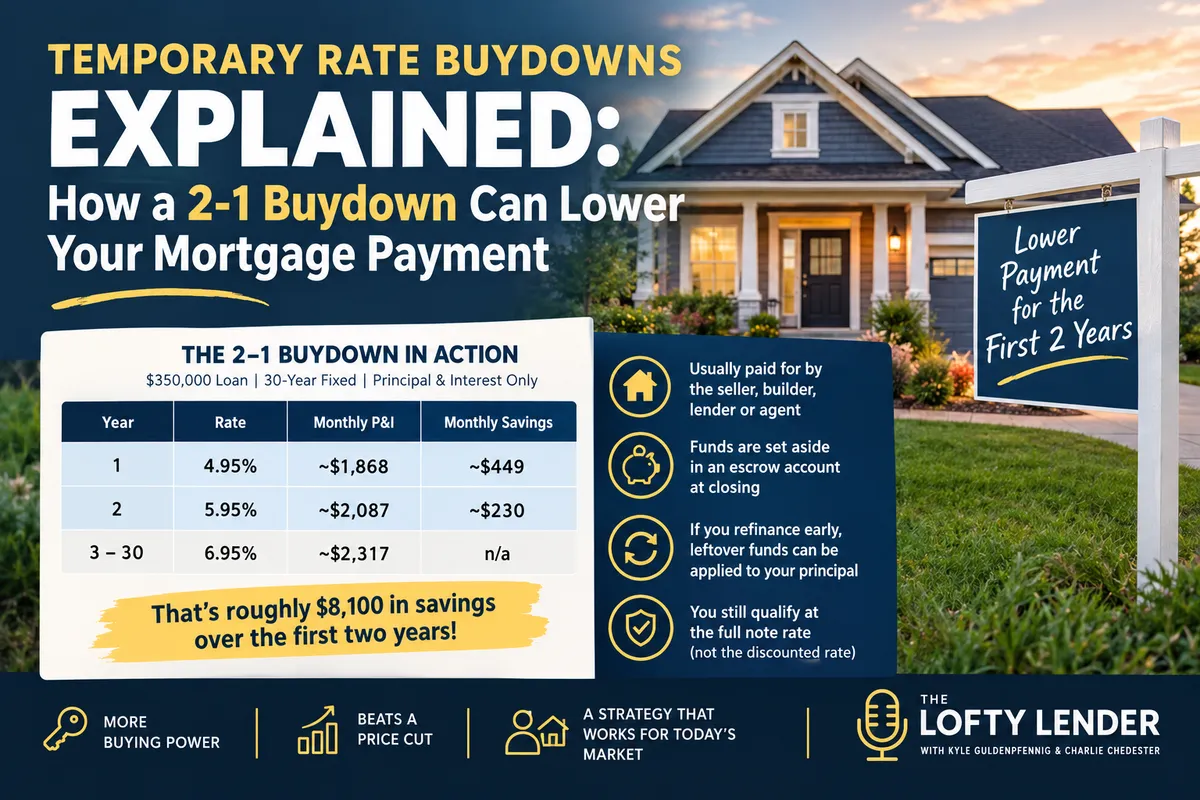
Here's the example I walked through on the show, using a $350,000 loan and Freddie Mac's 30-year average of 6.95% at the time we recorded (principal and interest only):
Rate | Monthly P&I | Monthly savings | |
|---|---|---|---|
Year 1 | 4.95% | ~$1,868 | ~$449 |
Year 2 | 5.95% | ~$2,087 | ~$230 |
Years 3 to 30 | 6.95% | ~$2,317 | n/a |
That's roughly $8,100 in savings over the first two years, and about what a seller would put in to fund it.
Now compare that to an $8,100 price cut. That only lowers the payment around $50 a month. Same seller dollars, very different impact on the buyer's first two years.
Where does the money actually go?
This is the part that confuses people. You don't technically have a 4.95% rate. The buydown money gets set aside in an escrow account at closing, and each month the lender pulls from that account to cover the gap between your reduced payment and your full payment. Charlie compared it to how your taxes and insurance sit in escrow and get paid out for you.
And here's the detail I love: if rates improve and you refinance before the two years are up, the leftover money isn't lost. Say you're 18 months in and there's $800 still sitting in that account. That can be applied straight to your principal balance. Charlie pointed out this is a newer feature compared to buydowns he remembers from years ago, and it's a big deal.
A unique selling strategy for sellers
I got a call recently from a new investor who'd had a house listed for a while. He told me, "I could cut the price, but everybody's doing that. I need to be different." My answer: offer a temporary buydown instead. Not everybody is talking about it, and it can make your listing stand out. He'd never even thought of it.
Right now a lot of agents are telling me the same thing: "I thought I'd get five or six showings, and I've had nothing." Sellers and builders are feeling the squeeze too. Builders have carrying costs on spec homes, and sellers are paying a mortgage on a house they don't want while keeping it show-ready (trust me, I've been there, and living in a house with no family pictures on the walls gets old fast). That pressure is exactly why buyers have more room to negotiate in a rising rate market.
A real client story
I'm working with a client right now who originally wanted to ask for a lower price, repair money, and concessions. That's a lot to ask from one seller. Instead, she went in with a full price offer and asked for the 2-1 buydown plus some money for repairs. She got it.
Her rate is a full 2% lower in year one. She's growing in her career, her income is getting more consistent, and she just had a baby. Those first couple years are exactly when a lower payment matters most, and by year three she'll be in a much stronger spot. Charlie said it best: that first barrier of entry is always the hardest.
The training wheels analogy
The way I like to explain it: a temporary buydown is like training wheels on a bike. For the first couple of years, you've got some extra support while you get your balance, new house, new routines, new expenses. Then the training wheels come off and you're riding on your own.
Or think of it as a warm-up lap before the full race. (Charlie's response to this analogy was asking if he could just not run at all. Listen to the episode for the story about his office workouts behind a curtain.)
Can your budget evolve?
Say you want your payment under $2,500, and the house you love lands over that. With a 2-1 buydown, year one and maybe year two could come in under $2,500, but year three will be over. So the real question is: can your budget evolve? Has it grown over the last few years? Do you expect raises? Is a daycare bill ending?
One important safeguard: you still qualify at the full note rate, not the discounted one. That means the lender has already confirmed you can handle the payment when it steps up.
What's happening with rates right now
At the time we recorded, Freddie Mac had the 30-year fixed at 6.95%, the highest in about eight months, compared to around 6.26% this time last year. The 15-year was at 6.26%. I always used to think of the 15-year as about 1% better than the 30-year, but that gap has narrowed. Charlie pegs it closer to three quarters of a percent right now, and it's a moving target.
My advice: don't let a rate headline scare you out of the market or push you into a decision you don't want. Charlie's go-to line when someone asks what rates are? "Between two and seven, what do you want?" You can find almost any rate advertised. The question is whether you're willing to pay for it. I get messages all the time about a 3.99% mailer. Right now, getting there could cost around $25,000 in points, and in my opinion that's rarely worth it.
Three actionable takeaways
Run the numbers both ways before you negotiate. Look at a standard 30-year payment next to a 2-1, a 1-0, or a 3-2-1. Know what you want before you write the offer.
Budget for the year-three payment, not the year-one payment. Don't count on rates dropping to bail you out. A podcast Charlie and I follow asked a question that stuck with me: what if we're only in the third inning of a nine-inning game? Plan for the payment you'll actually have.
Talk with your agent early about how to ask for it. A lot of agents aren't familiar with how buydowns work, and how you write the offer matters. As Charlie said, those details affect the financing and you can't always go back and change them later. I've got a one-minute video explaining buydowns, plus calculators for buyers and agents, and I'm happy to share them.
The bottom line
A temporary rate buydown lowers your payment for the first year or two, is usually paid for by the seller, builder, or lender, and can stretch concession dollars a lot further than a price cut. You still qualify at the full rate, so you're protected when it steps up. With rates hovering near 7%, it's one of the best tools buyers have to ease into homeownership.
If you want to see what a buydown would look like on your numbers, reach out. I'm just a call away.
Want to hear the whole conversation? Search for The Lofty Lender with #TallMoneyMan wherever fine podcasts are downloaded, and subscribe so you never miss an episode.
Payment example based on a $350,000, 30-year fixed loan, principal and interest only (excludes taxes, insurance, and mortgage insurance). Rates referenced are Freddie Mac's Primary Mortgage Market Survey average as of September 17, 2026. Your rate and terms will vary.