Rent or Buy in 2026? Why the Real Question Isn't the Price Tag
"Should I buy right now, or should I just keep renting?" It's the question Kyle Guldenpfennig gets asked more than almost any other. On a recent episode of the Lofty Lender Home Buyer Education podcast, Kyle sat down with Charlie Chedester to work through it properly, no sales pitch, just the actual math and the mindset that should drive the decision.
Here's what buyers weighing rent versus buy in the Des Moines and Omaha metros need to know right now.
Rates Are the Reason This Feels So Much Harder Than It Used To
Nationally, 30-year mortgage rates are sitting somewhere between 6.6% and 6.8%. On a $400,000 home, that works out to roughly $840 a month more than the same purchase would have cost back in 2021, when rates were near 3%. That gap is the single biggest reason the rent-versus-buy decision feels so much more complicated today.
Charlie summed up why predicting rates is nearly impossible right now: geopolitical events overseas are having more impact on daily rate movement than a borrower's own credit profile. Kyle shared a conversation with a client who asked what their rate would look like in two months. The honest answer: nobody knows. Rates now swing on international news and oil prices as much as anything happening in the U.S. economy.
The Local Numbers: Renting Looks Cheaper on Paper
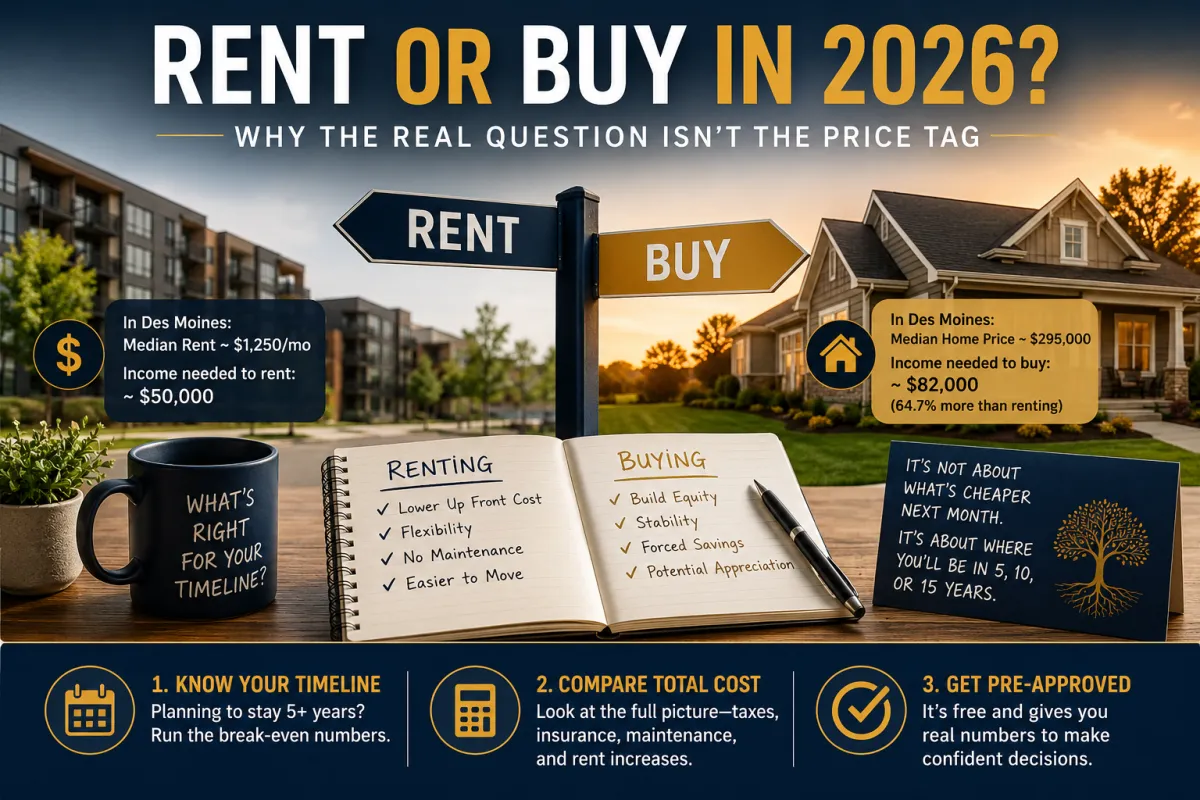
In the Des Moines area, the case for renting is fairly clear on a pure monthly-cost basis. Median rent runs around $1,250 a month. Buying the median-priced home, at roughly $295,000, takes an income of about $82,000, compared to around $50,000 needed to comfortably rent. That's a 64.7% income premium to buy over rent, actually higher than the 46.3% national average.
If money is tight, Kyle is the first to say renting can be the right call. But that's not the end of the conversation, it's the beginning of it.
The Real Question Isn't Price, It's Timeline
Kyle and Charlie kept circling back to the same point: the "is it cheaper" question only tells you about next month. It says nothing about year five or year ten.
If someone plans to stay in an area for 10 to 15 years, the math changes completely. If they're in town temporarily, say, finishing a two-year graduate program, with no fixed plans afterward, renting may genuinely be the smarter move. Buying and selling within two years is a real gamble. As Charlie put it, real estate isn't designed for people to be in and out of houses that quickly. Buy at the wrong point in the cycle and sell two years later, and you might be writing a check at closing instead of walking away with a profit.
The Tree vs. Potted Plant Analogy
Kyle offered an analogy that captures the tradeoff well: renting is like buying a potted plant, while buying a home is like planting a tree.
The potted plant is easy. It's flexible, costs less up front, and you can move it wherever you want, whenever you want. Planting a tree costs more up front and takes a few years before it really takes off. But leave that potted plant in place for ten years, and you've spent the whole time paying for a plant that was never yours to keep. The tree, given enough time, pays for itself many times over.
The mistake, Kyle noted, is planting a tree when you only plan to stay two years. You absorb all the up-front cost and never get the shade.
Don't Skip the "What Are We Buying" Conversation
Charlie raised a point that doesn't get talked about enough: budget-appropriate expectations matter as much as the rent-vs-buy math. Not every home needs to be move-in ready and picture-perfect. Charlie, who lives on the west side of Des Moines proper among older homes, pointed out that plenty of buyers pass on solid, safe houses simply because they're not "done" yet, no fresh paint, no updated landscaping, nothing shiny.
Those houses, as long as the foundation is sound and there's no water intrusion, often represent the best opportunity. A little sweat equity, cleaning up brush, repainting, going through the property over time, can be a far more affordable path into ownership than competing for a fully renovated home at a premium price.
Total Cost, Not Just the Payment
One of the biggest mistakes buyers make is comparing rent directly to a mortgage payment. That's not an apples-to-apples comparison. A mortgage payment is just the starting point, property taxes, insurance, and maintenance all stack on top of it. On the rent side, you have to factor in that rent tends to climb every year while a fixed mortgage payment doesn't move.
There's also a piece that's easy to underestimate: forced equity. Kyle shared that he recently sold his own home and ended up making significantly more than he likely would have saved in cash on his own, simply because the value of the home increased while his principal balance decreased. When he sold, that difference came back to him in cash, a forced savings account he didn't have to think about. It's also one of the few ways to build wealth without paying capital gains tax, within certain limits.
Charlie added an honest, relatable point: even disciplined savers who set money aside often end up spending it on a vacation or a home renovation rather than actually investing it. A mortgage payment forces that savings whether you feel like it in the moment or not. Homeownership also tends to shift lifestyle spending in ways that aren't captured in a simple rent-vs-mortgage comparison, more time and money invested in the house itself, and often less spent going out.
Three Actionable Takeaways
Kyle and Charlie closed the episode with three concrete steps for anyone weighing rent versus buy right now:
1. Figure out your real timeline first, not your payment first. If you know you're staying five-plus years, run the actual break-even numbers before assuming renting is automatically the smarter move just because it's cheaper today.
2. Compare total cost, not just the payment. Rent versus a mortgage payment isn't apples to apples. Factor in taxes, insurance, and maintenance on the buy side, and expected rent increases on the rent side, before comparing the two numbers.
3. Get pre-approved, even if you're just looking. It costs nothing and turns the decision from a guess into real numbers you can actually compare against your current rent.
The Bottom Line
Renting looks cheaper almost everywhere right now, including in Des Moines and Omaha, but that's a snapshot, not the whole picture. The real question isn't "rent or buy," it's "how long am I staying?" That answer is what should actually drive the decision.
Listen to the Full Conversation
This article covers the highlights, but the full episode goes deeper into real client stories, the psychology of saving versus forced equity, and how to know when you're actually ready to buy. Search for The Lofty Lender with #TallMoneyMan wherever fine podcasts are downloaded to listen to the complete episode and catch every future one.
Wondering whether renting or buying makes more sense for your specific timeline? Reach out to your Lofty Lender team, we're happy to run the numbers with you.