Making the Mortgage Process Easier: What Charlie and I Actually Ask For (and Why)
Making the Mortgage Process Easier: What Charlie and I Actually Ask For (and Why) | Lofty Lender
If you've ever felt like the mortgage process was throwing "one more thing" at you every few days, you're not imagining it, and you're not alone. On this week's episode of The Lofty Lender, my co-host Charlie Chedester and I got into exactly why that happens, and more importantly, what actually makes it feel easier.
Here's the truth: almost none of the individual steps in a mortgage are hard on their own. Uploading a pay stub isn't hard. Signing a form isn't hard. What makes the whole thing feel heavy is not knowing what's coming next or why it's being asked for. So that's what we unpacked.
"Kyle, now what?"
I hear this constantly. A buyer gets pre-approved, we ask for a stack of documents upfront, and then months later, once they've found a house, they brace themselves for round two. Except there usually isn't one. If we did our job right at the start, "now what" usually means signing one letter of explanation or clearing up an address that popped up on a report. That's it.
Charlie put it well: we try to do all the heavy lifting up front so that later on, we're just filling in the blanks. The catch is timing. If you're house hunting for a few months between getting pre-approved and writing an offer, we'll need an updated pay stub or bank statement just to make sure nothing's changed. That's not a new mountain to climb, it's just keeping your file current.
Why we ask for so much financial detail
Buyers sometimes push back on how much we need to know, and honestly, I get it. Common sense says "leave me alone, why do you need all this." But when you're asking to borrow hundreds of thousands of dollars, the institutions behind that money want to know the full picture of your financial situation. It's not personal.
Charlie broke down the real reason behind it: lenders exist as a checkpoint against illegal money entering the real estate system, and a safeguard against putting buyers into a loan they can't actually handle. Nobody wins when there's a foreclosure, not the buyer, not the neighborhood, not the lender. So while the process of proving where every dollar came from can feel invasive, the goal behind it is protection, both for the system and for you.
Underwriters always have questions. Always.
Here's something I tell every client now: I have never once had an underwriter come back and say "yep, everything's perfect, no questions." Not once, not even with the simplest file, fixed income, no unusual money movement, nothing complicated. Their entire job is to scrutinize every document and ask enough questions to fully understand your file.
The first time I didn't set that expectation with a client, they panicked when a condition came back, convinced something had gone wrong. It hadn't. A couple of conditions after your initial approval isn't a red flag, it's just underwriting doing its job. Once you know that ahead of time, it stops feeling like a crisis and starts feeling like a normal step.
Use the secure portal, not your email
One more thing Charlie and I always ask: please stop emailing us your social security number, tax returns, or bank statements. We get it, it feels faster. But your inbox isn't encrypted, and if anyone ever gets into it, that information is just sitting there. That's exactly why we built a secure upload portal, so your sensitive documents stay protected the whole way through.
And a small bonus tip while we're at it: don't black out or white out information on your statements before uploading them. Underwriting won't accept a redacted document, they've seen thousands of bank statements and they know exactly where your name and account number are supposed to be.
The bottom line
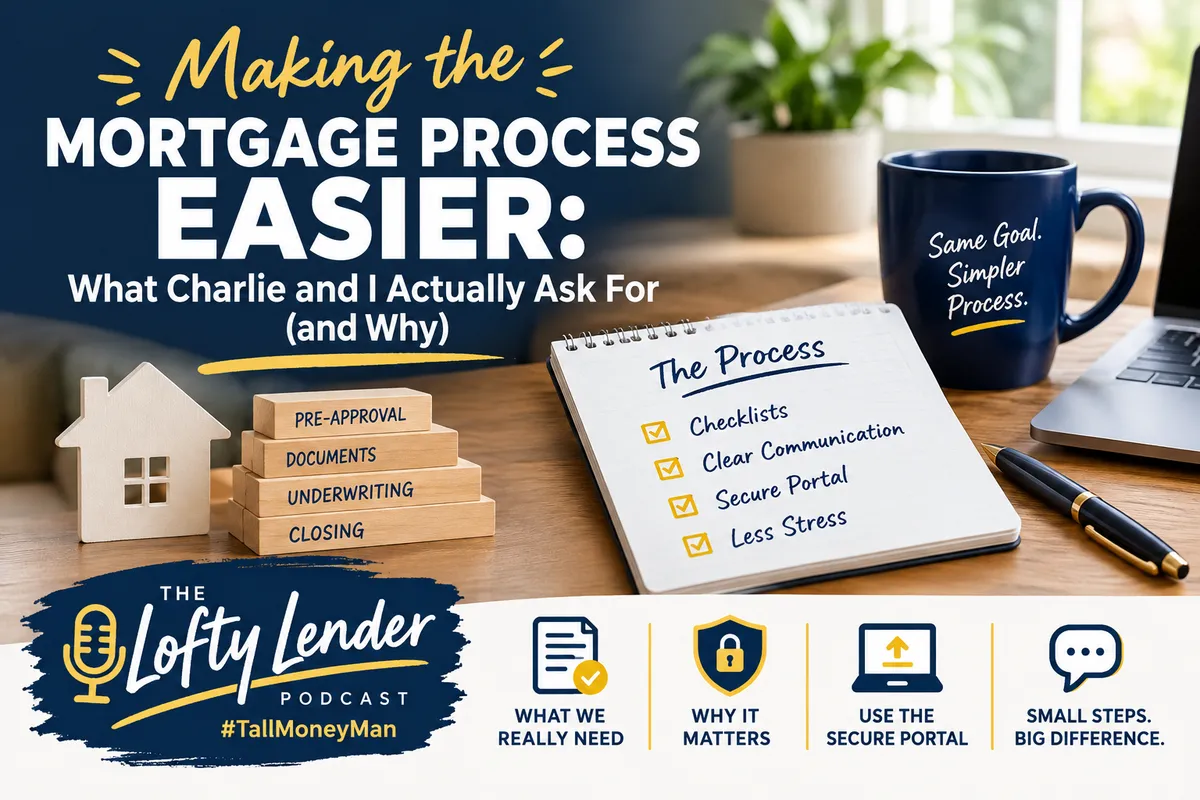
The mortgage process only feels difficult when it's unclear. Ask your lender for a document checklist before you're asked for documents. Use the tools they offer instead of playing email tag. And if it feels like a lot, tackle it in small chunks instead of all at once. Give it structure and a little bit of communication along the way, and it stops feeling like a mountain and starts feeling like a checklist.
If any of this sounds like your situation, or you've just got questions, reach out. That's what Charlie and I are here for.
Want to hear the whole conversation? Search for The Lofty Lender with #TallMoneyMan wherever fine podcasts are downloaded, and be sure to subscribe so you don't miss next week's episode.