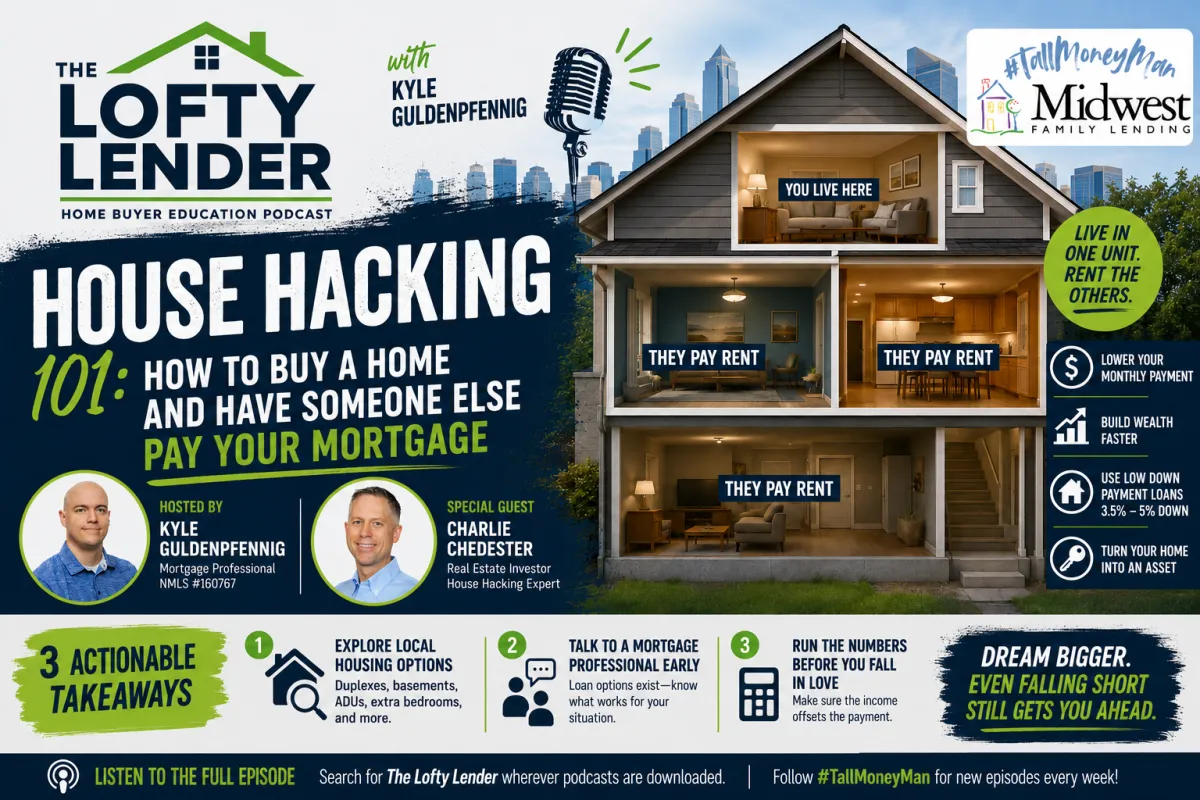
House Hacking 101: How to Buy a Home and Have Someone Else Pay Your Mortgage
By Kyle Guldenpfennig | The Lofty Lender
The term "house hacking" gets thrown around a lot on social media, but is it real? Is it legal? Can someone actually buy a home and have another person cover the mortgage payment?
The short answer: yes. And it might be one of the smartest moves a first-time buyer or aspiring investor can make right now.
On a recent episode of The Lofty Lender Podcast, host Kyle Guldenpfennig sat down with Charlie Chedester to break down exactly what house hacking is, how it works, and how everyday buyers are using it to build serious wealth, including one person who retired at 29 with seven rental properties.
What Is House Hacking?
House hacking simply means buying a property you live in while also generating income from it. It turns a home, typically the biggest liability most people carry, into an income-producing asset.
As author Robert Kiyosaki points out in Rich Dad Poor Dad, a home is a liability if it is only costing money. House hacking flips that equation.
Common house hacking strategies include:
Buying a duplex and renting out the other unit
Purchasing a triplex or fourplex and living in one unit
Renting out a finished basement or spare bedroom
Building or utilizing an accessory dwelling unit (ADU)
Short-term rentals via Airbnb or similar platforms
Renting to a trusted friend, roommate, or family member
Charlie shared his own experience: his first property was a duplex. He rented the bottom unit for more than half the mortgage and took on roommates over the years. The result? His housing costs were nearly zero.
The Biggest Misconception About House Hacking
According to Charlie, the number one mistake people make is having unrealistic expectations, thinking house hacking will immediately level them up to a luxury lifestyle.
"House hacking isn't meant to necessarily level you up when you're starting," Charlie said. "It's meant to break down that barrier."
The analogy holds with buying a first car. Going for the fancy one right away makes everything else harder. Starting modest, offsetting costs, and keeping options open is the smarter play.
Real-World Examples From the Episode
The Brother Roommate: Kyle shared a story about a buyer who had his brother move in and pay "half the rent," which actually turned out to be a little more than half because the brother had the better-paying job. A smart arrangement for both sides.
The College Town Play: Kyle and Charlie discussed Charlie's daughter heading off to college. Rather than paying over $12,000 per year in rent, they are seriously considering buying a property near campus, letting her live there, and converting it to a rental when she moves on. The numbers make a compelling case.
The Church Friend: Kyle knows someone who bought his first home, fixed it up, rented it out, and repeated the process. That person now owns seven or eight rentals, most on Airbnb, and calls himself retired at 29. His secret? The right expectations. He never held out for the perfect house. He bought what he could, added value, and moved on.
The Basement Renter: Kyle rented out his basement to his best man's sister while she attended a Des Moines university. She was quiet, her parents paid on time, and the extra income went straight toward paying down the mortgage.
Can First-Time Buyers Use Low Down Payment Loans for House Hacking?
Yes, and this is where things get especially interesting.
FHA loans allow as little as 3.5% down on properties up to four units, as long as the buyer lives in one unit as a primary residence.
Conventional loans can allow as little as 5% down on a duplex as a primary residence.
Some programs will use average market rents to qualify a buyer, even without a tenant already in place.
The catch: multi-unit properties, especially older ones built in the 1930s through 1950s, can carry deferred maintenance issues. Kyle and Charlie both emphasized verifying that any property being considered is actually rentable before falling in love with it.
3 Actionable Takeaways
1. Explore local housing options. Look for duplexes, triplexes, fourplexes, homes with finished basements, separate entrances, or extra bedrooms. The right opportunity may already exist in the local market.
2. Talk to a mortgage professional early. Not every property qualifies for every loan program. Financing a four-unit property works very differently from financing a single-family home. There are also non-QM loan products specifically designed for house hackers and investors worth exploring.
3. Run the numbers before falling in love. Calculate what income the property could generate and whether it meaningfully offsets the monthly payment. As Kyle put it, dream bigger: even falling short of the biggest goal usually lands someone in a better place than they imagined before.
Is House Hacking the Right Move?
For anyone asking whether they can afford a home right now, Kyle suggests flipping the question: is there a way someone else could help offset the payment?
Is there a friend or family member who needs a place to stay?
Is there an extra bedroom, basement, or unit that could be rented out?
Is there someone nearby going through a life transition, like a divorce, a move, or starting college, who needs temporary housing?
Any of those situations could be the entry point.
Listen to the Full Episode
Search for The Lofty Lender wherever fine podcasts are downloaded and follow along using #TallMoneyMan to stay up to date on every episode. New episodes drop weekly covering home buying tips, mortgage strategies, and real stories from real buyers.
Whether someone is a first-time buyer, a move-up buyer, an investor, or just looking to learn, The Lofty Lender has something for them.
Stay curious. See you next week.
Kyle Guldenpfennig is a mortgage professional and host of The Lofty Lender Home Buyer Education Podcast. This post is based on a recorded conversation with Charlie Chedester and is intended for educational purposes only. Loan program details and eligibility requirements vary. Consult a licensed mortgage professional for advice specific to your situation.