Why Consistency Beats a Perfect Budget Every Time | The Lofty Lender
I sat down with Charlie Chedester for this week's episode of The Lofty Lender, and we ended up spending almost the whole conversation on one idea: most people don't actually have a budget problem. They have a consistency problem.
You've probably done this yourself. You build a great budget in January, you follow it for three weeks, and by March it's a forgotten tab in a spreadsheet somewhere. It's not that the plan was bad. It's that life doesn't move in a straight line, a slower month, a surprise expense, a good excuse to celebrate, and one inconsistent month turns into six.
The Number That Started This Conversation
I found a stat before we recorded that stuck with me: nationally, one in four homebuyers, 25%, end up going over the budget they originally set for their home purchase. The number one reason isn't a single bad decision. It's the accumulation of not having a consistent read on what they can actually afford.
That stat reminded me of a client I talked to recently. Before he'd even looked at a single house, he called me and said, "Kyle, I need to figure out what I can afford before I go looking." I about spit out my coffee. Most people fall in love with a house first and find out the numbers second, and by then it's a lot harder to walk away from something you've already pictured yourself living in. He and his family had simply built the habit of following their budget first, every time, before making a decision. They weren't experts, they just knew to ask the question in the right order.
As Charlie put it during the episode, you don't have to be great at a budget to be good at spending less than you make. You just have to do it consistently, in the right order, every time.
Why "I'll Start Monday" Doesn't Actually Work
Building a habit is genuinely hard. Some people say it takes 28 days, some say 40, and honestly, for most of us it takes longer than that. The habits that actually stick are the ones that become close to automatic, something you're doing without having to think hard about it every single time.
That's the whole idea behind paying yourself first. Set up an automatic transfer into savings on payday, before the money ever lands in your checking account, and you remove the decision entirely. I did this myself years ago with a modest $100 a month into an IRA. I barely noticed it was gone. Looking back at it now during an annual review, that "forgettable" hundred bucks a month has genuinely added up. Compound interest is a lot more fun when it's working in your favor instead of sitting on a credit card balance.
Budgets Fail When There's No Room to Breathe
One pattern we see constantly: someone comes in with money split across two or three accounts, a little here for bills, a little there for everything else, and they're constantly juggling to avoid overdraft or late fees. Our advice is almost always the same. Consolidate everything into one account and stop moving money around. Then set a real floor for that account, maybe $200 to start, and treat that number as your new zero. When your balance shows $200, that's empty to you. Once you hit $300, that's a genuine, bank-account-growing win worth noticing.
That little bit of breathing room is what makes a budget survivable. A razor-thin budget gets abandoned the first time something unexpected shows up, a water heater dies, the power goes out and takes a few appliances with it. A budget with a small cushion survives real life, which means it's the one you'll actually keep using.
The Habit That Should Scare You a Little
We also talked about a client who was ready to buy, found a house he loved, wrote an offer, and then got cold feet. On paper, his numbers worked. When we went through his bank statements together, we found he was spending over $500 a month at the convenience store, breakfast, lunch, and dinner, every single day. I asked him if buying the house might naturally push him toward the grocery store instead. His answer was honest: "Probably, but that's just my habit. Buying a house doesn't automatically change it."
That's the real lesson. A house payment doesn't fix your spending habits. But if you want something badly enough, and you're willing to actually change the habit standing in the way of it, the math usually works itself out.
Don't Skip the Emergency Fund Conversation
This isn't just a homebuying issue. Nationally, only about 47% of people could cover a $1,000 emergency expense right now, and 24% have no emergency savings at all. That gap is exactly what turns a manageable surprise, a closing cost adjustment, a repair right after move-in, into a real crisis. Building even a small cushion before you need it changes the entire experience of homeownership.
Three Things You Can Actually Do This Week
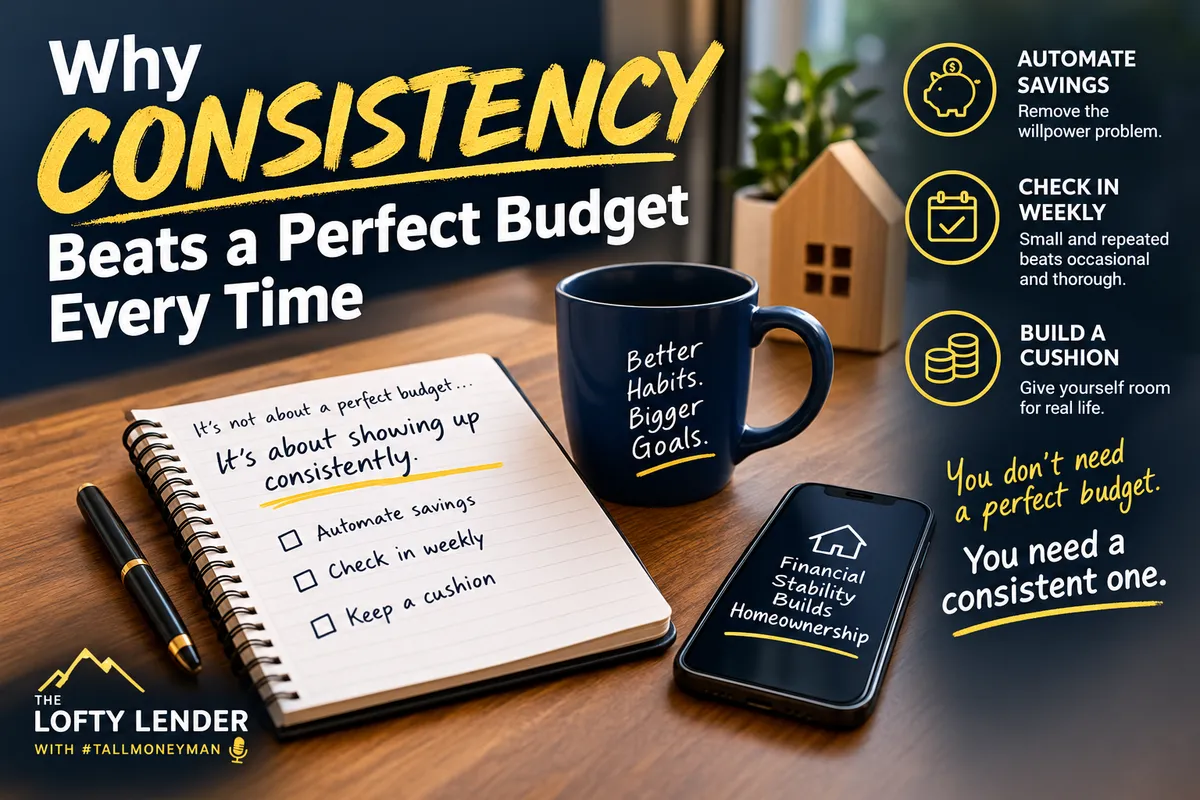
Automate one transfer. Even $50 or $100 a month into savings, moved automatically on payday, removes the willpower problem entirely.
Do a five-minute money check-in weekly, not a once-a-year deep dive. Glance at what came in and what went out. Small and repeated beats occasional and thorough.
Consolidate your accounts and set a real floor. Stop juggling money between accounts to avoid fees, and give yourself a small cushion so one surprise expense doesn't derail the whole plan.
You don't need a perfect budget. You need a consistent one. Small, repeatable habits, automated where you can, beat an ambitious plan that only lasts a few weeks.
If any of this sounds familiar, or you want to talk through what your own numbers actually look like before you start house hunting, reach out. I'm always happy to help you get that consistency in place.
Search for The Lofty Lender with #TallMoneyMan wherever fine podcasts are downloaded to hear the full conversation with Charlie, including the story about his real reason for double-checking his credit card statement every week.